In His Name, the Most High

The Hawza

How a student of the hawza learns, from the first grammar book to independent research.

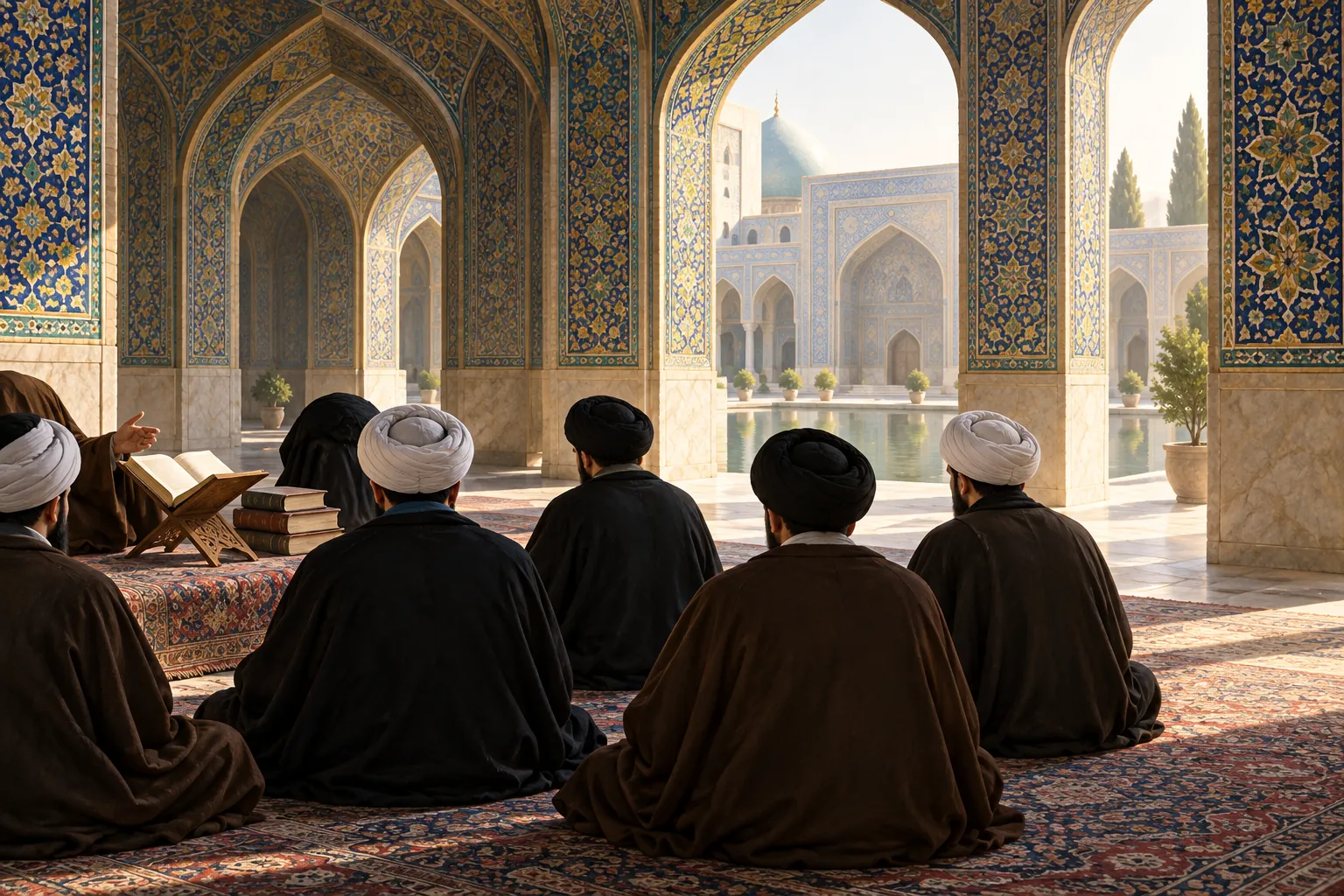
A lesson in a tiled portico: students in turbans and robes, seen from behind, sit on carpets facing their teacher, beside a carved book stand holding an open book; a courtyard and a dome lie beyond the arches.

Qom in Iran and Najaf in Iraq are the two leading centres of Twelver Shi‘i seminary learning. Neither is simply one university with one syllabus. Each is an educational community of schools, teachers, senior jurists, libraries, and research institutions.

The heart of this training is fiqh, Islamic jurisprudence, and usul al-fiqh, the theory and methods of legal reasoning. Arabic, logic, theology, Qur’anic interpretation, and hadith studies support that training.

New to these words? The glossary explains them.

This page describes the common traditional pathway and important institutional differences—not a verified, school-by-school timetable for the current academic year. Textbooks, required chapters, duration, and supplementary subjects vary.

The four stages

Some descriptions count three stages, treating higher sutuh as part of sutuh; others distinguish four. This is largely a difference in classification.

  1. Foundations · Muqaddimat

    Acquire Arabic and intellectual tools for reading scholarly texts.

    Arabic morphology (sarf), syntax (nahw) and rhetoric (balagha); logic (mantiq); basic beliefs, ethics, and practical law. The goal is not merely conversational Arabic. Students must distinguish precisely what a Qur’anic verse, hadith, or scholarly sentence says.

    At this point, a student principally learns what the ruling is. Later study asks what evidence establishes it, and whether that reasoning withstands criticism.

    Representative books: Al-Ajurrumiyya, Qatr al-Nada, Sharh Ibn ‘Aqil and Mughni al-Labib for grammar; al-Muzaffar’s al-Mantiq for logic.

  2. Text-based intermediate study · Sutuh, singular sath

    Understand and critically analyse established works of law and legal theory.

    In fiqh, Sharh al-Lum‘a: the underlying text is by al-Shahid al-Awwal, and the commentary is by al-Shahid al-Thani. Its importance is its breadth: students encounter many branches of law while learning concise arguments, distinctions, and objections.

    In usul: usul is the methodological centre of the advanced hawza. It asks how a jurist can responsibly move from evidence to a ruling.

    Representative books: Sharh al-Lum‘a; al-Muzaffar’s Usul al-Fiqh; al-Sadr’s al-Halaqat, a graded sequence that revisits legal theory at increasing depth.

  3. Higher intermediate study · Sutuh ‘ulya

    Master difficult analytical texts before advanced research.

    Al-Makasib, by Shaykh Murtada al-Ansari, is central to higher intermediate fiqh. Its educational value exceeds its subject matter. The student learns to disentangle layered arguments, identify assumptions, and assess objections to competing positions.

    Sharh al-Lum‘a gives broad legal coverage; al-Makasib provides intensive analytical training in a narrower area.

    Representative books: Al-Makasib; Fara’id al-Usul, commonly al-Rasa’il; Kifayat al-Usul.

  4. Advanced research · Bahth al-kharij

    Examine sources and arguments beyond dependence on a prescribed textbook.

    “Kharij” means outside: outside dependence on a prescribed textbook—not outside Islam or outside the seminary. A senior jurist presents a problem, examines the sources, reconstructs earlier scholars’ arguments, criticises them, and develops a conclusion.

    Attending kharij does not automatically make a person a mujtahid. Ijtihad is a scholarly capacity, recognised through demonstrated ability and sometimes an ijaza. Becoming a marja‘, a recognised authority for emulation, is a further matter—not the automatic final grade of a degree programme.

    Representative books: The course may follow the order of a book such as al-‘Urwa al-Wuthqa or Kifayat al-Usul; what changes is that the textbook no longer determines the answer.

Duration is not universal. Sources describe introductory study ranging from roughly two years for some Arabic-speaking students to four or more for students needing intensive language training. Advanced study is open-ended.

Alongside the ladder

Qur’an, hadith, and narrator evaluation

‘Ilm al-rijal evaluates transmitters and chains of transmission. Students investigate identities, reliability assessments, possible discontinuities, and disputed judgments about narrators. A report appearing in a major Shi‘i collection is not thereby automatically accepted as authentic by every Usuli jurist.

This is the science Sanad serves: what each book of rijal says about a narrator, attributed and located, with no verdict of its own.
Theology, philosophy, and ‘irfan

Kalam develops and defends religious doctrines; falsafa or hikma addresses philosophical questions about existence, causation, knowledge, and the soul; ‘irfan may refer to theoretical mystical thought or practical spiritual formation. Their place depends on the institution and scholarly circle.

How a student studies

A characteristic study cycle combines:

  1. PreparationReading the passage and identifying difficulties before class.
  2. DarsAttending the teacher’s explanation and analysis.
  3. MubahathaDiscussion with fellow students, reconstructing arguments and testing objections.
  4. Review and writingConsolidating the lesson and consulting further sources.

Mubahatha is particularly important. A student who can follow an explanation may still be unable to reproduce the argument or answer a serious objection. Peer discussion exposes that gap.

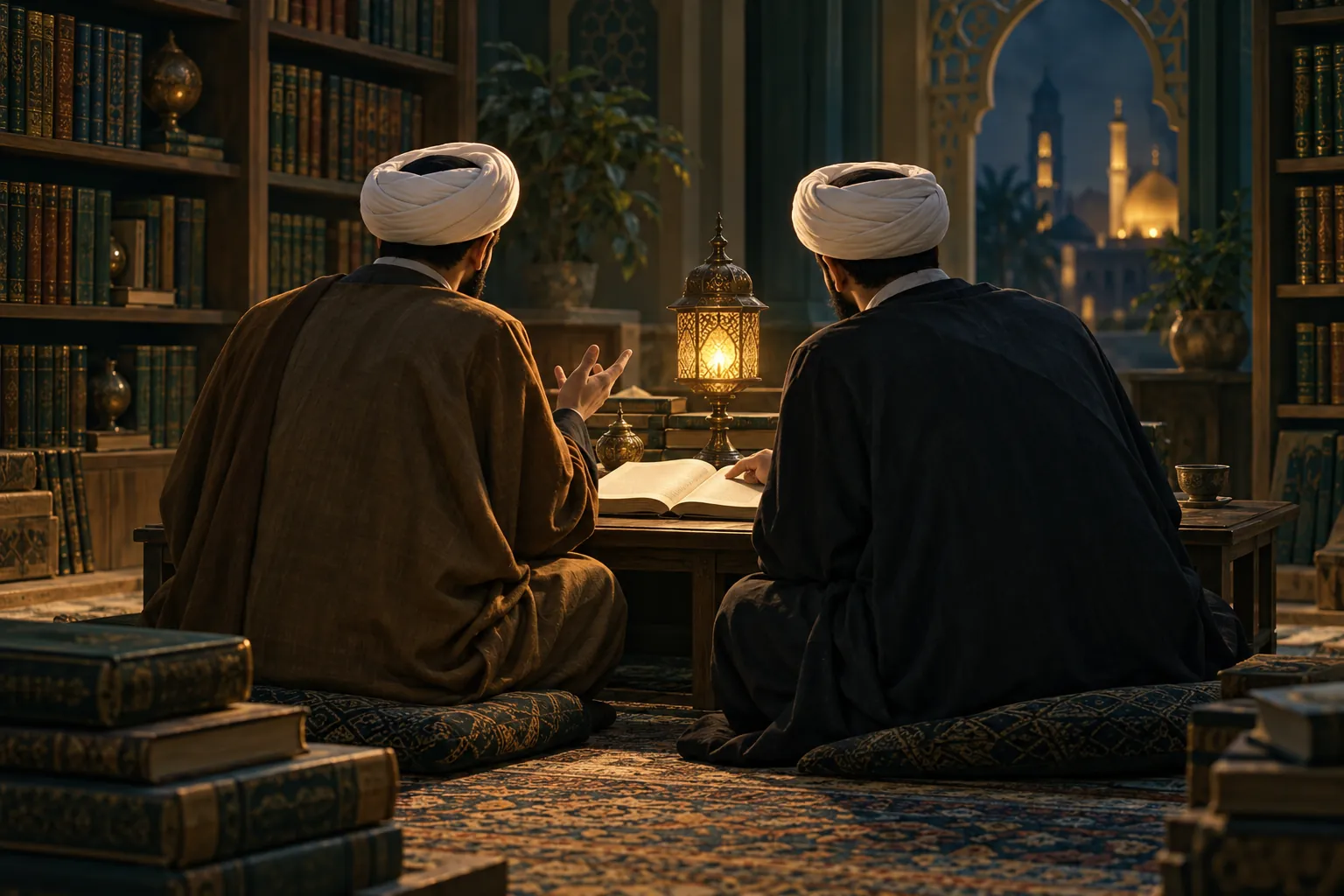
Two students, seen from behind, discuss an open book by lamplight at a low table among shelves of bound books; a lit shrine shows through the window.

Where Daftar fits

In Daftar, teachers and students keep what the dars and the mubahatha teach. They record a lesson if they choose, and write its questions and answers themselves, with their sources; a second scholar reviews each one. Nothing is written from someone’s lesson without them: the person who taught it decides what it says. The reviewed records become the training pairs from which our model learns the method. Transcribing the recordings is Daftar’s next step, so that review can return to the lesson’s own words.

One question through the whole curriculum

Consider an illustrative question: a person previously knew that they had performed ablution, but later doubts whether it was invalidated. How should the case be analysed?

This is an example of the learning process, not a personal religious ruling.

  1. FoundationsThe student reads the relevant Arabic correctly and understands the terms.
  2. Practical fiqhThe student learns the ruling given in their marja‘’s manual.
  3. Intermediate fiqhThe student studies the distinctions and supporting arguments.
  4. UsulThe student investigates istishab and the conditions under which an earlier state may be presumed to continue.
  5. Hadith and rijalThe student examines relevant reports and their transmission.
  6. KharijThe student assesses competing interpretations and whether the principle applies to the precisely defined case.

The whole syllabus is connected: language identifies the evidence; source criticism assesses it; usul establishes the method; fiqh applies that method to a concrete problem.

Qom and Najaf

Qom and Najaf do not offer two fundamentally different religions or two wholly separate textbook traditions. They share a large Twelver Shi‘i scholarly inheritance.

The main differences lie in organisation, language, institutional resources, available specialisations, and particular teachers’ approaches. Within either city, choosing a teacher or programme can materially change a student’s education.

AspectQomNajaf
Shared coreArabic, logic, fiqh, usul, and associated religious sciencesSubstantially the same traditional core
LanguagePersian is common in primary teaching; Arabic texts remain essentialArabic is the principal teaching language
OrganisationMore extensive central administration and numbered levels in regulated programmesTraditionally more teacher-centred and decentralised, though individual schools can have formal programmes

For the highest juristic pathway, the curriculum develops three capacities in order: understanding the sources, understanding scholarly arguments, and judging those arguments independently.

Back to the top